
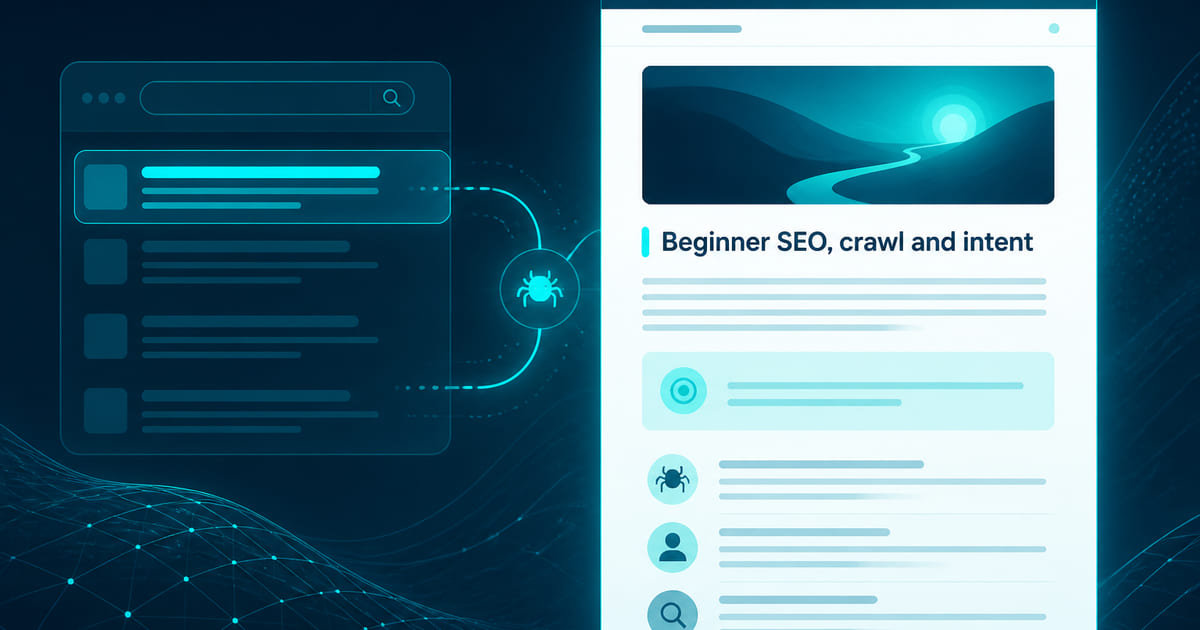
Key takeaways
- Beginner SEO is crawl, intent, and useful unique text. Keyword stuffing is a leftover habit, not a method.
- Learn how search works, then write one good page per query. Technical cleanup comes after that page exists.
- A plugin cannot sell you a ranking. Search still rewards a page a person can finish.
You published a services page last spring. A friend typed the thing you sell. Your URL was not there. The plugin still showed green. The first paragraph said the phrase four times.
SEO for beginners is not a density score. It is whether a crawler can fetch the URL, whether the page matches the job the person typed, and whether the text is useful and unique enough to retrieve. Keyword stuffing is leftover folklore. Search still rewards a page a person can finish.
This is the first path: how search engines work, then how to write one good page per query. How to rank your website is the later order — intent, technical health, mentions. Do not start there. Start here.
Search finds pages it can fetch
A search engine does three jobs with your URL. It finds the page. It stores what the page is about. Later, when someone types a query, it decides whether that page is worth showing.
Finding is crawl. A bot follows links and sitemaps and requests the HTML. If the URL is blocked, locked behind a login, or never linked from anywhere, the bot may never see it. That is not a ranking problem. It is a discovery problem. A page that cannot be crawled cannot be found.
Storing is index. The system keeps a representation: the title, the headings, the visible text, the links. It tries to learn what the URL is for. If the title names one job and the body names another, the index stores a contradiction. If the page is empty, the index stores almost nothing.
Showing is retrieve. A person types a query. The system picks URLs that look useful for that job, relative to other URLs, right now. Useful means the person can finish the page and take a next step without being misled.
You do not control the third job. You control whether the first two are possible, and whether the page is worth the third. That is the whole beginner model. A stuffed first paragraph is not. A file sitting at the root of the site is not.
If a checklist starts with "add keywords" and never asks whether a crawler can fetch the URL, it is teaching the wrong first move.
Write one page that finishes one query
The query is a job. The page should do that job.
Someone typed a phrase because they want a fact, a comparison, a next step, or a reason to trust. Your URL either finishes that work or it wastes the crawl. "Small business SEO guide" is not a license to list every service you sell. It is a license to teach the beginner path, then point at the work that follows.
One useful page per query. Not twenty thin URLs that restate the homepage. Not a FAQ farm that asks questions the body never answers. A page with no single purpose should not enter the technical queue yet; resolve the editorial job first.
A buyer should actually type the query. You should stand behind the answer. Two URLs that say the same thing are one URL. Answer in the first screen. Match the title to the body. Show the next step. If the heading says one thing and the third paragraph says another, you taught the index a contradiction.
This is the same discipline as SEO and GEO for small businesses: one public truth in the title, the heading, the body, and any structured data you add later. Volume is not intent. A small map of pages a skeptical buyer will finish beats a large map of pages a plugin generated.
Useful unique text is not "nobody used these synonyms." Unique is a page that would still help if every competitor page disappeared. It names the job, states the facts you will defend, and leaves a next step. It uses the nouns a buyer already uses — website, offer, form, crawl, index — because those are the nouns, not because a tool counted them.
If you would not send the page to a skeptical friend, it is not ready. A crawler will still fetch it. That does not make it worth retrieving.
Use the crawl–index–retrieve diagnostic
When a page is missing from search, work in order.
Crawl
Can a crawler request the URL and receive the intended content? Check status code, robots rules, authentication, rendering, internal links, and whether the canonical host is reachable.
Index
Is the page eligible and selected for indexing? Check noindex directives, canonical signals, duplicate versions, content visibility, and Search Console inspection. A crawled URL is not automatically indexed.
Retrieve
Does the page deserve to appear for the query relative to alternatives? Check intent match, completeness, originality, evidence, title and heading, page experience, internal context, and external recognition.
Write the diagnosis before the fix: “The URL is not indexed because the production template retained noindex,” or “The page is indexed but does not answer the comparison query in its title.” This prevents teams from rewriting content to solve a robots problem or chasing backlinks for a page that duplicates another URL.
Google’s documentation describes Search as crawling, indexing, and serving results, and notes that not every discovered page is crawled or indexed. The beginner lesson is not that the system is simple. It is that the failure stage can usually be named.
Once the page is eligible, write for the person. Use the words they use in prominent locations, answer the job fully, and add something the existing results do not. There is no preferred word count and no universal keyword density.
See Google Search Central — How Search works and Google Search Central — Crawling and indexing.
Keyword stuffing still fails for the same reason
Old beginner guides taught a count. Repeat the phrase. Put it in the title, the heading, the first sentence, the image filename, and the footer. Hope the index prefers the page that said the phrase most often.
That was a story about a dumber system. It trained people to write pages nobody would finish. It still shows up as "on-page SEO basics." It is not.
Repeat a noun when it is the noun. "Website" belongs on a page about websites. "SEO for beginners" belongs in a title that teaches beginner SEO. Counting either wastes the hour. A stuffed paragraph is a retrieval problem and a trust problem. The person leaves. The system learns the page did not do the job.
If a vendor sells density, they are selling a 2012 screenshot. Write the useful page. Then make sure a crawler can fetch it.
Titles that match the body they sit on
The beginner on-page list is short. Finish it on the URLs that already do a job.
Give the document one title and one heading that name the same job. Do not bait a query the body will not finish. The first screen has to make the fact literal. Prefer concrete nouns over adjectives.
Leave a next step that works. A form that submits. A phone layout that does not fight the thumb. Web development that skips this is not done.
Keep the packaging honest. Titles, descriptions, and structured data may clarify a visible fact. They may not invent a service or a proof the visitor cannot read. What llms.txt is — and what it is not is the same rule for agents: a README, not a ranking lever. Write one after the pages exist.
That is on-page SEO when you strip the folklore. Not a keyword in every heading. Not a plugin that paints a green score while the page is set to `noindex`.
SEO and content is the ongoing version of that job: keep the facts current, keep the pages crawlable, keep the claims honest. It is not a ranking product. It is how a presence stays one company after the first publish.
Clean the pipes after the writing
A good page that cannot be crawled cannot be found. A crawled page a person cannot use will not keep the attention it briefly got.
After the intent is real and the text is useful, check the boring list. The URL is not `noindex` by accident. `robots.txt` is not blocking the HTML you want retrieved. One URL is the URL. A relevant page links to it. A phone can read it. The form submits. Speed is permission for the copy to be read. It is not a strategy.
Do not start here. A crawl-budget seminar will not save a slogan. Fix crawl and speed on the URLs that already do a job. Do not "optimize" a URL that should not exist.
The longer technical order — indexable, canonical, discoverable, usable, fast enough — lives in how to rank your website. Mentions come after that. Do not buy links. Do not fake reviews. Earn evidence from work other people can cite. The technical SEO checklist is the punch list once you have pages worth the crawl.
A score cannot invent a page
Do the beginner work yourself when you can write the offer in one sentence and stand behind it. Name the queries that deserve a URL. Write one page per query. Make those pages crawlable before you argue about keywords. Do not stuff phrases, buy links, or publish a number the visitor cannot see.
Skip the SEO project when the homepage is still mush, the offers are still being invented, or someone is asking you to "add keywords" to a site that cannot yet explain itself. In that case the next step is not a plugin. It is the pages.
A settled offer with weak public expression requires page architecture and ongoing search work, not another plugin score. Our own record can support a narrow claim, but it does not exempt any page from answering the query well. Structured data and notes for agents are byproducts of pages we will stand behind. They are not the product.
Nobody can sell you a ranking. What they can do is put useful pages on a site that can be crawled, and keep those pages honest.
If the site does not yet say the thing, start with the site. If the site says three things, pick one and write one page that finishes one job. The later order is how to rank. The first order is this page. Get started when you want both in one build.