
Key takeaways
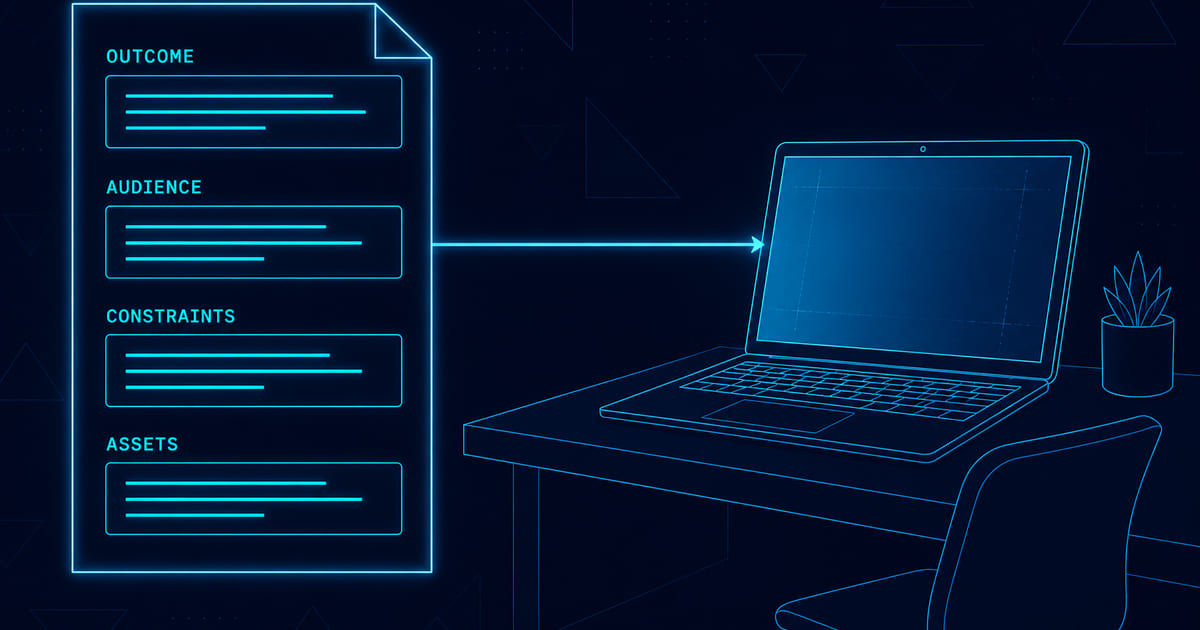
- A brief a remote team can start from names the outcome, the audience, the constraints, and the assets.
- A moodboard without a decision is taste with no owner. Write the pick, then attach the pictures.
- We work remotely as part of the client's team. You review decisions. You do not sit behind a ticket wall.
You sent twenty screenshots and a Slack note that said "something like this, but ours." The first draft looked like the board and nothing like the business.
That is how a remote creative brief dies. A good brief names the outcome, the audience, the constraints, and the assets you already have. A moodboard without a decision is not a brief. A Pinterest board is not a brief. A thread that outsources the pick is not a brief. They leave a remote team guessing, then you pay for the guess.
Write the decision. Attach the files. Name what you will refuse. Taste is not a spec.
Outcome, audience, constraints, assets
A brief is a job a stranger can start without sitting in your office.
It names the result you will accept. It names who the work is for. It names the constraints that will kill a draft — time, brand rules, tech, legal, what you will not ship. It names the assets the team can use: current site, logo files, photos you have rights to, copy you will stand behind, a competitor you will not copy.
That is a website project brief when the job is a site. It is a brand brief when the job is a mark and a system. The container changes. The four fields do not.
Outcome is the result you will accept, in a sentence a buyer would use. "A site a stranger can finish on a phone, with a form that submits" is an outcome. "A modern web presence" is a vibe.
Audience is who pays, what they already tried, and what would make them leave. "Everyone" is not an audience. "The modern brand" is not an audience.
Constraints are facts. Launch date. Languages. The CMS you will keep, or the one you will leave. Colors you must keep. Pages you will not build this month. Legal lines you cannot say. The competitor you will not look like.
Assets are files they can open. Current URL. Logo files, not screenshots of the logo. Photos you have rights to. Copy you will stand behind, even if it is rough. A brand kit if you have one.
An in-house hire can walk to your desk and ask. A remote team cannot. If the decision is still in your head, the first round will be a guess.
Write the failure conditions before the references
A strong brief describes not only the desired result but the ways the result could be rejected. That lets the team kill a weak direction early, before polish makes it expensive.
Use this compact acceptance block:
- Outcome: what must be true after launch.
- Audience action: what the intended person should understand or do.
- Required evidence: facts, assets, or messages that must appear.
- Technical constraints: sizes, formats, platforms, languages, accessibility, performance.
- Non-negotiables: legal language, existing equity, prohibited claims, immovable dates.
- Decision owner: one person who resolves conflicts.
- Acceptance test: the observable condition that marks the work complete.
For a landing page, “modern and premium” is not an acceptance test. “The offer, proof, and form remain usable at 320 CSS pixels; the form submits; the approved analytics event fires” is. For a brand kit, “feels bold” is not. “The one-colour mark remains legible at the minimum approved size and the supplied files cover print and screen use” is.
Then add references with annotations. Every reference needs a reason: hierarchy, pacing, material, type, camera, interaction. “We like this” transfers taste but not intent. “Use this density, not this colour” transfers a decision.
Remote work amplifies ambiguity because informal correction arrives later. The answer is not more meetings. It is a brief that makes tradeoffs visible and names the person who can settle them. A five-page document with no acceptance test is less useful than one page that can reject a draft.
The public pages are Digital.gov — Plain language guide and W3C — WCAG 2.2.
A board is a reference after the pick
A moodboard is useful after the four fields exist. It is a reference, not a job.
Teams send twenty screenshots and no outcome. They send a folder of logos they like and no audience. They send "clean, premium, not like the last one" and no constraint. Then they are surprised when the first draft looks like the board and nothing like the business.
A moodboard without a decision is taste with no owner. The designer has to invent the offer, the audience, and the stop line. That is not design. That is you outsourcing the brief and then rejecting the invention.
Keep the board if it helps. Write the decision first. If two images on the board contradict each other, pick one. If you cannot pick, you do not have a brief yet. Circle the one you mean. Write why. Delete the rest from the working set, or label them as "not this."
A folder of logos with no pick produces a copy or a drift. A Slack thread with five owners produces a stall. The four-field brief produces a start.
Brief them as if they will never sit down
Brief a remote designer the way you would brief someone who will never sit in the room.
Write the outcome in one sentence a buyer would use. Name the audience. List constraints as facts. Attach assets. If you do not have a kit, say so. Do not send a JPEG of a mark you found and call it the identity.
One owner for decisions. Remote work fails when five people reply "not quite" and nobody can accept a direction. Name the person who can say yes. The team will work with that person.
A Slack thread is a conversation. It is not a brief. If the decision moved, update the written brief. Do not expect the designer to mine the thread.
Briefing an agency is the same four fields, plus who holds them. You are not hiring a pair of hands to decorate a sentence you have not written. You are hiring a team that will carry the brief across design, copy, and build. If you keep the brief in your head, you become the scheduler. That is a real job. It is also the job you thought you were buying.
Write what you will accept. Write what you will refuse. Write who reviews. Write when a round is done. Then let the team do the work.
Writing web copy a buyer can finish is the same discipline in words: claim, reason, next step. A capability list is not a claim. A vibe is not an outcome.
If the comparison you meant was a seat, that is in-house hire vs CLICK.BLUE. If it was a bid, that is CLICK.BLUE vs freelance marketplaces. Both still need a brief. A marketplace bid without the four fields is a cheap guess. A seat without a brief is an expensive one.
Inside the client's Slack
CLICK.BLUE works remotely as part of the client's team. We are not a vendor behind a wall, and we are not a replacement for every internal hire. We sit in the client's Slack. We hold the written scope. We do not need a chair in your office to be on the team.
We have worked this way since 2014 — twelve-plus years, fifty-plus businesses, a hundred-plus websites. You review decisions. You keep running the business.
A website project brief applied to a presence looks like this.
Outcome: what the site must do. A stranger can name the offer, believe one reason, and take one next step. Not "redesign." Not "refresh the look."
Audience: who arrives, and from where. Search, referral, a campaign, a buyer who already knows the name. If those people need different pages, say so. Do not ask one URL to be all of them.
Constraints: pages you will ship this month. Pages you will not. The offer you will stand behind. The CMS. The form that has to work on a phone. What you will not claim.
Assets: the current site, the logo and branding kit if it exists, photos, copy, analytics you will share. If the mark still fights the pages, that is branding first — a short kit so the next ten assets do not drift. If several pages have to work as a presence, that is a full website, not a longer moodboard.
Web development is how that brief becomes a site: structure, copy, pages that hold up, a path that actually submits. The brief is the job. The build is the delivery.
Attach files they can open
Remote work dies on assets that are not assets.
A screenshot of the logo on a wide hero is not a logo file. A photo you found and cannot license is not an asset. A competitor URL with "make it like this" and no pick is not an asset. A PDF of an old brand book nobody follows is a rumor.
Send the current URL. Send vectors if you have them. Send photos you have rights to, or say you have none. Send copy you will stand behind, even if it is rough. Send the analytics login or an export if the job is a site. If a constraint is legal, send the line you cannot cross.
Name the file. Date it. Put it in one place. Do not ask the team to reconstruct the brief from six threads and a drive they cannot access.
If the identity is still mush, start with the logo and branding kit. If the presence is the job, that is the full website. Branding is the system. Web development is the build.
A paragraph is enough to start
You do not need a twelve-page creative brief template.
You need the four fields in writing, one owner, and the files attached. A short paragraph that names outcome, audience, constraints, and assets is a brief. A long deck that names none of them is not.
Do this yourself when you can finish those four sentences and accept a direction. Send it before the first working session. Update it when the offer changes.
Skip the template theater when the work is still "we will know it when we see it." In that case the next step is not a designer. It is the decision.
Write the four fields this week. Then start a scoped proposal. A remote team can begin when the job is on the page.