Key takeaways
- The connector is a cable. The integration is auth, mapping, failure, retry, monitoring, and an owner.
- Write the data contract before you buy Zapier credits or an enterprise middleware slide.
- Name who owns the retry when the third party returns 429 at 2 a.m.
Sales bought the CRM. Product wants leads in it automatically. Someone on the call said Zapier fixes everything. Three months later quotes sit in a spreadsheet because nobody scoped what happens when the API rate-limits you on a Friday.
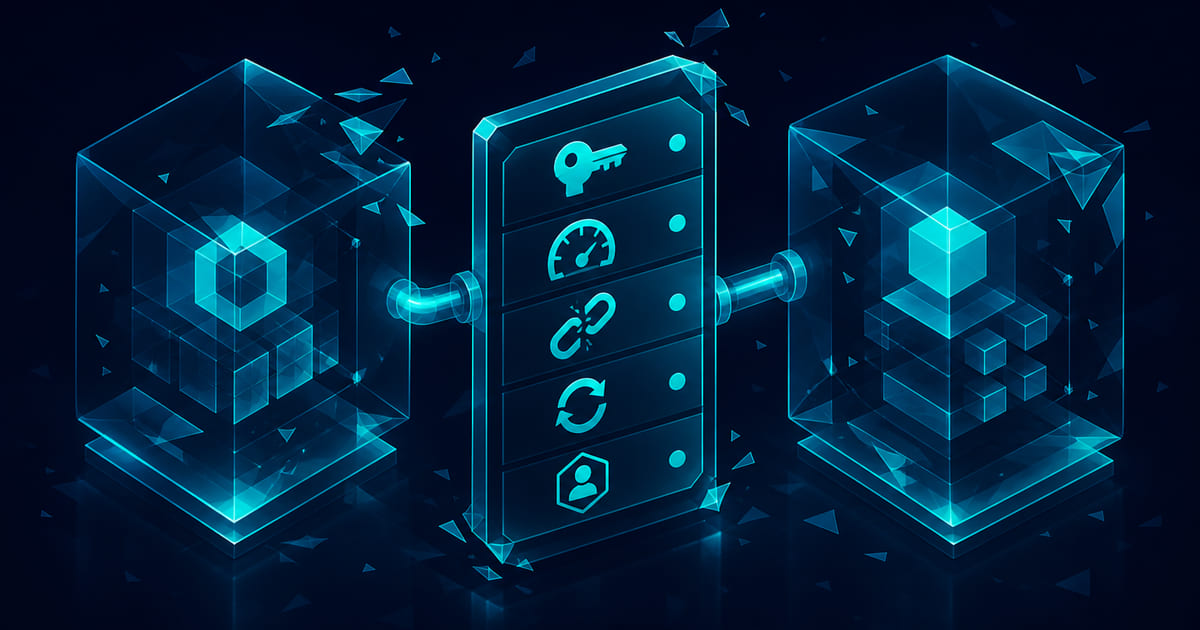
How to scope an API integration starts with a data contract — not a logo slide of connected boxes. The connector — Zapier, Make, a native plugin, custom code — is transport. The integration is authentication, field mapping, idempotency, failure handling, retries, monitoring, and a human owner when the queue backs up.
How to build for the web in 2026 treats integrations as part of operating ownership. Website care vs rebuild reminds you that brittle plugins become recurring emergencies. This page is the worksheet before anyone writes code or buys a plan tier.
Data-contract worksheet
Fill this before you evaluate tools:
Systems and direction
- Source system — form, product database, billing, support desk
- Destination system — CRM, ERP, data warehouse, email platform
- Direction — one-way push, pull, or bidirectional sync
- Trigger — real-time webhook, scheduled batch, manual export
Entities and fields
List each record type — contact, deal, invoice, ticket — and map fields explicitly:
| Source field | Transform | Destination field | Required? |
|---|---|---|---|
| `email` | lowercase trim | `Email` | yes |
| `service_interest` | enum map | `Pipeline` | yes |
| `utm_campaign` | pass-through | `LeadSource` | no |
Ambiguity here becomes silent data loss. "Company name" in the form is not obviously "Account.Name" in the CRM. Write the transform.
Identity and deduplication
- How do you recognise the same person across systems — email, external ID, custom key?
- What happens on duplicate create — skip, merge, update?
- Are deletes propagated or ignored?
Stripe's idempotency documentation is the gold standard mindset even when you are not billing cards: safe retries require keys.
Auth, rate limits, and secrets
Authentication types:
- API key in header — simplest, easiest to leak in client code
- OAuth client credentials or authorization code — better for SaaS products, more moving parts
- Signed webhooks — verify sender, not just payload shape
Store credentials in environment config. Rotate on staff changes. Scope keys to least privilege — read-only where possible.
Rate limits:
Read the vendor limit docs before launch. HubSpot API usage guidelines and similar pages name daily and burst limits. Plan batching, backoff, and queueing when imports spike — say, after a webinar.
Document what you do on `429 Too Many Requests` and `5xx` errors. "Retry three times with exponential backoff" is a spec. "Hope it works" is not.
Failure, retry, and observability
Every integration fails. Scope the behaviour:
1. Transient failure — network blip, rate limit. Retry with backoff. Dead-letter after N attempts. 2. Permanent failure — invalid payload, missing required field. Alert a human. Do not retry forever. 3. Partial success — parent record created, child failed. Define compensating action or reconciliation job.
Someone must see failures without reading server logs. Minimum viable observability:
- Log integration run ID, source record, destination ID, status
- Alert on queue depth or error rate threshold
- Weekly report of failed rows until stable
Name the owner of the retry. If it is "whoever is online," you do not have an integration. You have a hobby.
Connector vs custom integration
| Factor | No-code connector | Custom code |
|---|---|---|
| Time to first sync | Hours | Weeks |
| Complex transforms | Painful | Natural |
| Versioning and tests | Limited | Full |
| Cost at scale | Per-task pricing | Engineering time |
| Audit trail | Vendor-dependent | You build it |
Connectors win for straightforward one-way pushes with stable fields. Custom wins for bidirectional sync, complex validation, and regulated data. Hybrid is common: connector for happy path, small service for edge cases.
Fair to connectors: they are cheap to try. Fair to engineering: they become expensive when logic outgrows the visual editor and nobody can diff changes.
Security and compliance checkpoints
- PII only crosses the wire you need — do not mirror entire profiles "just in case"
- Data processing agreements with vendors where required
- Webhook endpoints authenticated and HTTPS-only
- Sandbox testing before production keys touch real customers
OWASP API Security Top 10 is the checklist for anything you expose publicly — including inbound webhooks.
AI agents add a second contract
AI agents that call tools are integrations with non-deterministic callers. Scope separately:
- Which tools may write vs read
- Human approval gates for destructive actions
- Cost ceilings per run
- Logging of prompts and tool payloads retained how long
An agent that creates CRM records needs the same idempotency and failure discipline as a form post — plus authority boundaries.
Document sandbox vs production environments in the worksheet. Too many integrations go live because someone swapped keys at midnight without a checklist. A one-line environment column prevents the classic "test contact in the CEO's CRM" incident.
What you can draft alone
You can complete the data-contract worksheet in a working session with sales and ops. You can read vendor rate-limit docs and sketch retry rules on one page.
You should not productionise bidirectional sync without tests and monitoring. You should not embed API keys in the browser for convenience.
CLICK.BLUE scopes app development integrations as part of the product boundary — not as a surprise line item after launch. An app prototype proves the critical path sync before you scale connectors across the business.
Twelve-plus years, fifty-plus businesses, a hundred-plus websites — the integrations that survived named an owner and a failure mode. The rest became folklore.
Bring the worksheet. We will tell you if the connector is enough — or where the contract still has holes.