
Key takeaways
- AI compresses drafts. It does not own taste, QA, or launch. A human still owns what ships.
- Use AI for first passes and variants after the decision exists. Do not use it to invent the offer.
- We use AI in production. We do not sell prompts. What goes out under your name still has a person on it.
The draft arrived in ten minutes. It could belong to any competitor. Someone still has to decide what ships.
That is how AI changes creative production. AI for creative teams compresses drafts. It does not own taste, QA, or launch. The model is faster at a blank page than a person. It is not the producer. Human-plus-AI work still needs someone who will refuse a plausible line, catch a broken form, and put their name on the publish.
We use the tools. We like them. We do not sell prompts. A prompt is a start. A ship is a decision.
If the question you meant was who should do the work — you in a chat window, or a team — that is productized creative versus DIY AI. The rest of this note is how a team should use AI once production is already the work.
Drafts got cheap. Wrong still costs.
The blank page got cheaper.
Headline options in ten minutes. Layout explorations before lunch. Social variants from a paragraph you already stand behind. A first pass at alt text, a meta description, a FAQ nobody wanted to write from scratch. That is real compression — AI in web design production as a faster first mile.
What changed is the cost of a draft. What did not change is the cost of being wrong in public.
A draft that could belong to any competitor is still a draft. A layout that folds on a phone is still unfinished. A caption that invents a claim is still a liability. Speed without an owner is just more files.
The useful change is this: the team spends less time staring at empty frames and more time choosing. Choosing is the job that was always expensive.
Three jobs the model cannot take
Taste. The model does not know which service you actually sell, which competitor you will not look like, or which blue is yours. It will give you a plausible brand. Plausible is how five companies in the same city start to look related. Taste is the refusal. A person still holds the brand — the mark, the type, the few rules — and throws out the draft that almost works.
QA. The model does not sit with the form on a phone. It does not know the estimate drops on Safari, the contrast fails on the button, or the image has no rights. AI proofreading design can flag a typo and suggest a contrast fix. It cannot certify the page. A person still opens the URL a stranger will open.
Launch. Publish is not a generate button. Launch is titles, redirects, a working form, analytics that fire, a mobile layout that holds, and a sentence you will stand behind next quarter. The model will happily "ship" a folder. A producer ships a presence.
If you skip those three, you did not accelerate production. You accelerated a mess.
Add a provenance checkpoint before approval
Treat generated material as an input with a record, not as a mysterious finished asset. For every public-facing output, keep a compact provenance note:
| Field | What to record |
|---|---|
| Purpose | The job the asset must perform |
| Inputs | Brief, source files, references, licensed material |
| System | Model or tool and the date used |
| Human contribution | Selection, editing, compositing, writing, direction |
| Verification | Facts, rights, accessibility, brand, technical QA |
| Owner | The person who approves publication |
This is not bureaucracy for its own sake. It prevents three common failures.
First, the team cannot later explain where a claim or image came from. Second, generated material quietly inherits a reference the business did not have permission to use. Third, everyone assumes someone else checked the factual or legal edge.
The U.S. Copyright Office’s AI work keeps human authorship and human control central to copyrightability. Its report also notes that current systems may include elements a prompt did not specify and omit elements it did. That is a production fact even outside U.S. law: prompting is not deterministic art direction, and selecting an output is not the same as verifying every element in it.
Use AI aggressively for exploration, transcription, cleanup, variants, rough storyboards, resizing, and first-pass copy when those uses save real time. Raise the review bar as the output moves closer to a paid campaign, a public claim, a regulated category, or a permanent identity asset. The more durable the asset, the more durable the record should be.
The checkpoint ends with one name. “The model made it” is not an accountable approval state.
Rights and risk sit in the Copyright Office AI reports and the NIST AI Risk Management Framework.
Use it after you already decided
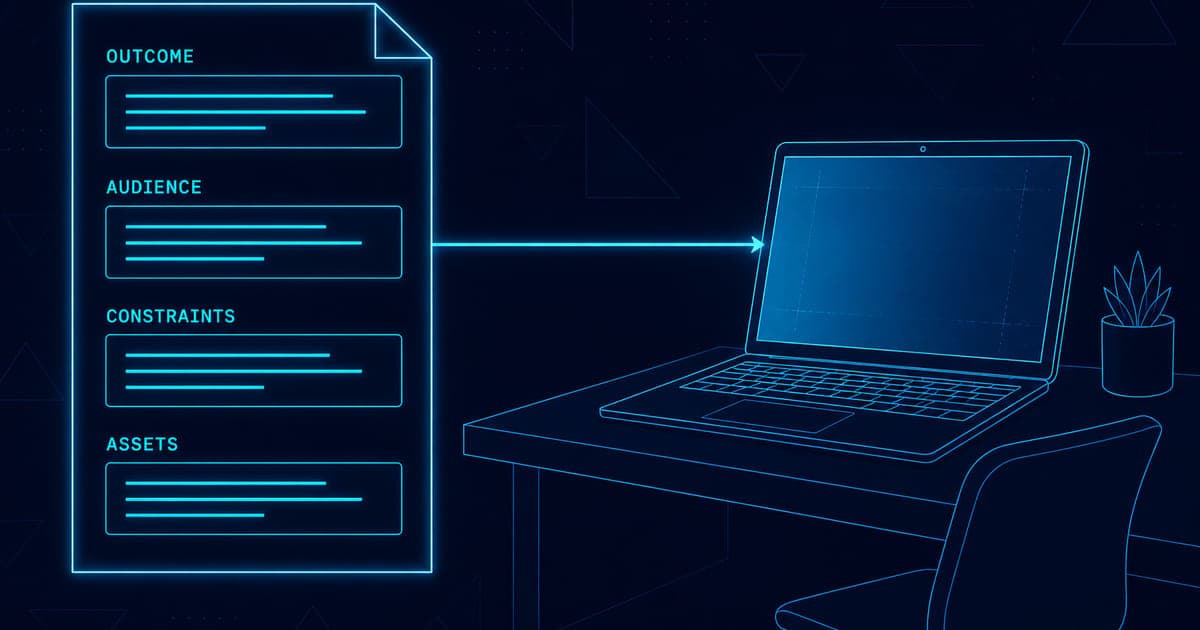
Write the brief first. Outcome. Audience. Constraints. Assets. The model cannot invent those without guessing, and a guess that looks designed is worse than a blank page. If the brief is mush, AI will make more mush, faster. How to brief a remote creative team is the four fields. The model sits after them.
Use the model after the decision exists:
- First-pass copy from a sentence you already accept.
- Variants of a layout that already has a system.
- Image explorations you will replace or license.
- Checklists: missing alt, weak contrast, a heading that says nothing.
- Internal drafts — a client update, a spec, a cut-down of a long page.
Do not use it to invent the offer. Do not use it as the art director. Do not use it as the QA lead. Do not use it as the person who clicks publish.
One owner for the outcome. The model can sit in every seat. It cannot be accountable in any of them. Five chats and a favorite is a raffle, not a team.
Keep the kit in the room. If you have a logo and branding kit, the model works inside it. If you do not, the model will pick a new blue every session. That is drift with a progress bar.
A thin login that stores your chats is not a production system. Same fork as SaaS is not dead — the wrapper is: a tool that owns a workflow is useful; a skin on a model is a moment.
Variants inside a locked system
AI in web design production is useful in a narrow band.
It is good at options. Six hero lines from one offer. Three mobile stacks from one desktop frame. A first pass at component copy: empty state, error, success. A list of pages you probably need, which a person then cuts.
It is bad at the site. It does not know the form has to submit. It does not know last year's offer is still in the footer. It does not know the CMS you will keep, or the one you will leave. It will design a page that looks like a page and behaves like a poster.
Web development is still the build: structure, copy a stranger can finish, states that exist, a path that submits. AI can draft the wire and the words. A person still has to make the page true.
Use it on the first mile of a full website — sitemap options, page outlines, alt drafts. Then stop. The second mile is brand fit, the form, the titles, the phone. That mile does not compress the same way.
Do not let the model pick type, color, and voice in the same sitting as the offer. Write the offer. Lock the kit. Then ask for variants inside those walls.
Catch typos. Do not certify the claim.
AI proofreading design is a real job. It is also a smaller job than the name suggests.
Use it to catch:
- Typos, doubled words, a heading that trails off.
- Missing alt, missing title, a button that says "submit" and nothing else.
- Contrast that fails a check, type that is too small on a phone-width frame.
- Inconsistent names — the offer called three things on one page.
Do not use it to certify:
- The claim. The model will smooth a sentence you cannot prove.
- The brand. It will accept a near-miss color and a mark that almost fits.
- The flow. It will not fill the form on a bad connection.
- The rights. It does not know which photo you can publish.
- The taste. "Looks clean" is not a review.
Proofreading is a pass, not a ship. A person still reads the page as a buyer and clicks what a buyer will click. Another prompt is not QA.
The honest loop is short. Generate. Reject most of it. Fix what you keep. Proof. Open the URL. Then launch. Skip "open the URL" and you launched a chat.
Human plus AI creative work is a split of ownership. The brief is written by a person, and that person can refuse a draft that ignores it. The draft is compressed by the model. The pick, the cut, and the rewrite stay human. Taste owns the kit and the no. Proof owns the facts, the rights, and the form. Launch clicks publish and stands behind it.
The model is faster when the producer is already at work. Reverse that and you get volume. Volume is not production.
We use the tools. We do not sell prompts.
CLICK.BLUE uses AI in production. We do not sell a prompt pack, a "custom GPT," or a seat that pretends to be a studio.
AI accelerates variations and first passes. Humans own brand fit, technical correctness, and what goes out under your name.
We have done this since 2014: brand, web, product, and the care that follows. More than twelve years. More than fifty businesses. More than a hundred websites. The tools changed. The stop line did not.
If the identity is still mush, that is branding first — a logo and branding kit a second person can apply, including a model. If the presence is the job, that is a full website: pages a stranger can finish, a form that submits, a launch a person will stand behind.
The last word stays human
Stop the model when the next step is a decision, not a draft.
Stop on a claim, a near-miss color, a layout not opened on a phone, an image with no license, a form not filled, a page about to go public.
Those stops are the producer. AI did not remove them. It made them more important, because the draft now arrives looking finished.
When the work is a brand a buyer will judge, or a site a stranger will finish, the team still owns the outcome. The model can sit in the room. It does not get the last word.
Scope the work a person will stand behind. AI compresses the drafts. A human still owns what ships.